

Chicago is frequently cited as a leader in civic innovation. The city has invested in open data platforms, digital service delivery, and participatory initiatives to bring government closer to the people. However, for many Chicagoans, particularly at the community level, governance remains distant because residents are not involved in budget decisions and lack the critical understanding of government data required for accountability, which limits civic engagement. This gap between access and engagement is not unique to Chicago. But some of the most practical solutions to this challenge are not emerging from major U.S. cities or Silicon Valley; they are coming from across Africa.
Having observed how civic technology can go beyond information access and empower citizens to actively influence governance through my work promoting civic engagement and public finance transparency across Africa. Civic technologists have created tools that do more than publish information in countries where public systems are under strain and institutional trust is often fragile. They enable citizens to monitor, question, and shape governance in real time. Cities like Chicago, looking to increase participation and restore trust, can learn a lot from these innovations.
Transparency Must be Paired with Interpretation
Chicago has made significant progress in transparency. Its open data portal and public budget documents provide access to vast amounts of information on city operations, spending, and performance. But access does not equal usability. For many residents, interpreting budget line items or navigating datasets requires a level of technical expertise that limits meaningful engagement. The information exists, but it is not always accessible in a way that informs everyday civic action.
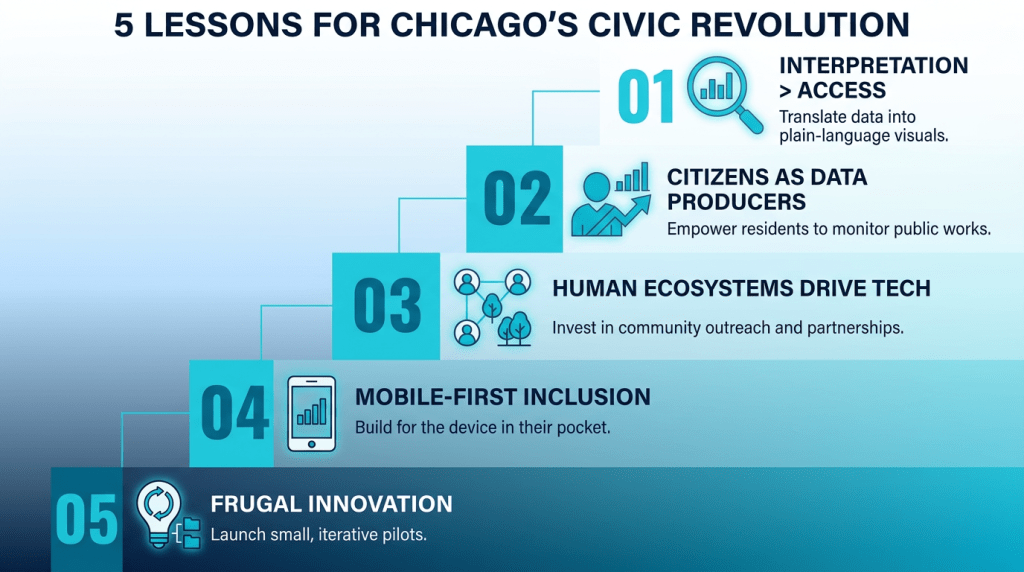
Across Africa, civic technology organizations have approached this differently. Rather than focusing solely on publishing data, they prioritize making it understandable. Organizations like BudgIT have built tools that translate complex government budgets into simple visuals, infographics, and plain-language explanations. Instead of expecting citizens to interpret dense fiscal documents, these tools answer practical questions: How much is being spent in my community? What projects are funded? What should I expect to see?
It is not enough to have open data; Chicago must ensure that it is usable and help citizens understand how it affects them.
Citizens as Data Producers, Not Just Service Users
Chicago residents are already familiar with civic reporting through the city’s 311 system, where residents can report potholes, broken streetlights, sanitation issues, and other service concerns. It is one of the most widely used civic tools in the city. However, the system is “complaint-based”: a resident makes a request, a ticket is created, and it is routed to a city department, rather than one that actively manages or repairs infrastructure holistically.
This process does not offer explanations for critical patterns such as where issues are concentrated, how quickly they are addressed across neighborhoods, and what they reveal about equity in service delivery. In many African contexts, civic tech has evolved beyond service requests into citizen-generated accountability systems.
Through initiatives like BudgIT’s Tracka, citizens monitor public projects such as schools, roads, and health centers and report their status in real time. We aggregate these updates, publicly share them, and use them to engage government officials directly and promote collective oversight. This example reveals that citizens are not just reporting problems; they are producing public evidence.
Chicago could improve its 311 system by making it easier for people to see and act on reports from their neighbors. Aggregated data could help residents, journalists, and community organizations identify trends, advocate for resources, and hold agencies accountable.
Technology Alone does not Drive Participation
Chicago has also experimented with participatory governance, particularly through participatory budgeting in select wards. Residents directly vote on allocating a portion of public funds, often for local infrastructure projects, through these initiatives. The model shows promise; however, participation levels vary, and engagement often limits itself to those already civically active.
One important takeaway from African civic tech is that technology alone does not drive participation. Successful initiatives combine digital tools with targeted community engagement. Citizens are taught how to interpret budgets, track projects, and communicate with public officials. Civil society organizations, local leaders, and media partners all play an active role in increasing participation and maintaining interest.
In other words, civic tech works best when it is embedded in a broader ecosystem of engagement. For Chicago, expanding participatory budgeting or digital engagement platforms should go hand in hand with deeper investment in community outreach, civic education, and partnerships with neighborhood organizations. Without such support, even well-designed platforms risk low adoption.
Inclusion Matters: Build with a Mobile-First Mindset
Another defining feature of civic tech across Africa is its emphasis on accessibility. Many tools are designed to function on basic mobile phones, using SMS or lightweight applications. This accessibility ensures that participation is not limited by access to high-speed internet or advanced devices.
Chicago is well-connected, but digital inequality persists. Many residents, particularly in low-income neighborhoods, rely heavily on mobile devices to access the internet. Others face challenges such as affordability, connectivity, and digital literacy. Designing civic tools with a mobile-first approach, simple interfaces, low data usage, and intuitive navigation can significantly increase participation rates. This approach also prioritizes inclusion, ensuring that civic engagement goes beyond those with the most resources.
The Case for Experimentation and Frugal Innovation
In Africa, civic tech innovations often emerge from constrained conditions, such as limited funding, infrastructure, and institutional support. This environment has fostered a culture of experimentation, in which developers quickly build solutions, test them in real-world scenarios, and iterate. In contrast, cities such as Chicago invest in large-scale digital systems that are expensive and slow to evolve. While these systems are useful, they can limit flexibility.
Chicago can experiment with smaller, community-driven pilots that test new ideas without requiring significant upfront investment by partnering with local technologists, universities, and civic organizations. The goal is not to replace existing systems but to create space for innovation that is responsive to community needs and feedback.
Rethinking Civic Tech as a Shared Responsibility
The most crucial lesson from African civic tech is its shared ownership, not limited to the government alone. It is an ecosystem comprising a multitude of stakeholders, including nonprofits, technologists, journalists, activists, and everyday citizens who collectively shape how information is produced, shared, and used.
In Chicago, civic tech often functions as a government initiative, occasionally supported by partnerships. Expanding this role into a more distributed model, where communities and civil society are co-creators rather than just users, could significantly strengthen accountability and trust.
Embrace the Shift in How Civic Technology is Understood and Applied.
Chicago does not lack data, tools, or talent. What it needs is a shift in how civic technology is understood and applied. African civic tech demonstrates that access alone does not lead to meaningful participation. It requires clarity, inclusion, community engagement, and a rethinking of who produces and owns public information.
At a time when trust in public institutions is under pressure, cities must look beyond familiar models for inspiration. Some of the most practical innovations in democratic accountability are emerging from places where citizens have had to build systems that work, often with fewer resources, but with greater urgency. Civic engagement’s future will depend on how well people use technology, not on its advancement.
The Real Lesson Isn’t About Technology. It’s About Trust.
Chicago is not short on data, tools, or talent. What it lacks, and what African civic tech has quietly been building, is a different relationship between citizens and the information that shapes their lives.
Across Africa, the most effective civic tools weren’t the most sophisticated ones. Communities used the tools built with them, not just delivered to them. Access, clarity, and ownership encourage participation.
This approach matters for Chicago right now. At a moment when public trust is fragile and civic disengagement is rising, the instinct to look inward to the same institutions, the same vendors, and the same frameworks is precisely the wrong response. Cities and countries where people couldn’t afford to wait for perfect conditions are producing some of the most insightful ideas on democratic accountability. They created what worked under pressure, and it worked because citizens were invested in the outcome.
Chicago must embrace the shift in how technology is perceived and used. Who asks the questions? Who controls the data? Who decides what accountability looks like on the ground? The cities that answer those questions well, regardless of their resources, will define what civic engagement means in the decades ahead. Chicago has what it takes to be one of them.
Abiola Afolabi, International Growth Director at BudgIT, writes from Chicago, IL.